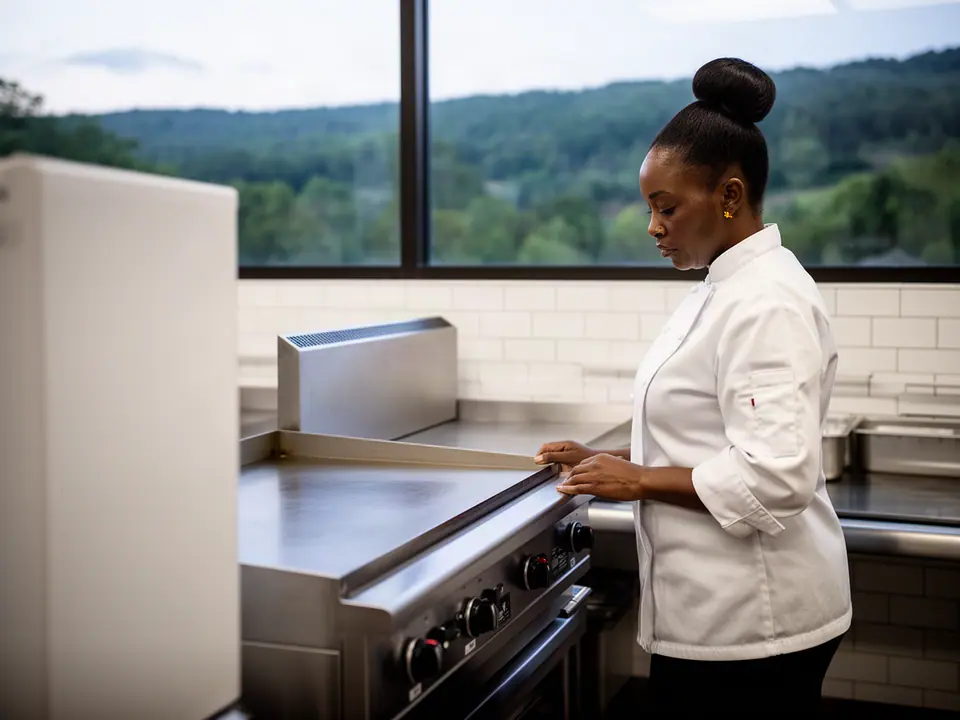
A salon business loan for a Zanesville, OH equipment refresh can come in two pieces: an equipment loan for new stations, color stations and dryers, and a term loan for movable lighting and freestanding furnishings. Fixed flooring and plumbing are excluded. Working capital can carry the salon through the weeks chairs are out of service. Rushstead brings the salon’s figures to funding partners, and each partner sets terms and decides.
Which funding type pays for which part of a Muskingum County, OH salon equipment refresh, with an invented six-station package worked from rounded payments, a downtime estimate, booth rent in the request, and beauty salon counts from County Business Patterns 2023 and Nonemployer Statistics 2024.
Styling stations, color stations and dryers
New stations, color stations and dryers can be identified by model and supplier price, making them suitable equipment examples. Fixed plumbing, supply lines and drains are excluded from funding through this site.
Illustration only, invented figures: a Zanesville, OH salon replaces its styling area with 6 stations at $1,450 each, adds 3 color stations with chairs at $2,150 each and 4 hooded dryers at $790 each. The equipment comes to $18,310; a supplier quotes $3,900 for rolling carts and freestanding mirrors; fixed plumbing is excluded.
| Item | Count | Invented cost |
|---|---|---|
| Styling stations | 6 | $8,700 |
| Color stations with chairs | 3 | $6,450 |
| Hooded dryers | 4 | $3,160 |
| Rolling carts and freestanding mirrors | 1 package | $3,900 |
Salon payrolls in the county are modest. County Business Patterns counted 20 beauty salon establishments with paid employees in Muskingum County, OH in 2023. Their combined payroll was $2.2 million for 98 employees, roughly $22,100 per employee on our arithmetic, so an equipment payment has to fit beside a modest wage line.
Equipment loan, term loan or working capital: who pays for what
Matching each cost to the right funding keeps the payments in line with how long each thing lasts:
| Cost | Funding that fits | Why |
|---|---|---|
| Stations, color stations, dryers | Equipment loan | The equipment secures the loan |
| Rolling carts, mirrors, movable lighting and freestanding furnishings | Term loan | Supplier-quoted movable items; fixed room work is excluded |
| Slow weeks while chairs are out | Working capital | Short-term cash, repaid as bookings return |
| Retail shelving and opening product | Term loan or working capital | Depends on the amount and payback |
Illustration only, invented figures: the $18,310 of equipment on an equipment loan at 9.75% a year for 48 months runs $462.19 a month, $22,185.12 over the term. The $3,900 of rolling carts and freestanding mirrors plus $17,600 of movable lighting, freestanding furnishings and a reception counter goes on a term loan at 11.25% for 48 months: $558.29 a month, $26,797.92 in total. Together the salon carries $1,020.48 a month for four years on a $39,810 equipment and movable-furnishing package; fixed plumbing and flooring are excluded.
Keeping chairs booked during supplier setup
Every day a chair is out of service is a day of bookings that has to go somewhere else. Phasing supplier setup limits that: one group of stations at a time, the color stations on the days the salon is closed, and the movable reception furnishings last so the front door stays open. Fixed room work is excluded.
Illustration only, invented figures: even with phasing, 2 stations are out for 9 working days. At $240 of services per station a day, that is $4,320 of work to move to other chairs or lose. A $5,000 piece of working capital covers rent and payroll through those days without touching the equipment and movable-furnishing budget.
- Tell regular clients the dates in advance and offer the open chairs first.
- Book color and long services on the side of the floor that is finished.
- Ask the supplier for a written schedule with a date for each equipment phase.
- Keep the old dryers until the new ones are wired and tested.
Booth rent and retail income in the request
Not every salon dollar comes from services by the salon’s own staff. Booth renters pay rent to use a station, and retail product sales add a second income line. Both belong in the request, shown apart from services, with the paperwork that supports them.
Illustration only, invented figures: 3 renters at $165 a week bring in about $2,145 a month, and retail sales add $1,900. A funding partner can read that rent as steady income when the booth agreements are in writing and the deposits appear in the bank statements every week.
- Signed booth rental agreements with the weekly rent and the term.
- Point-of-sale reports splitting services, retail and rent.
- Statements from the salon’s business account, three to six months back, where the weekly rent lands.
- Supplier quotes for equipment and movable furnishings; fixed room work is excluded.
Owner-only salons are common in the county. Nonemployer Statistics listed 250 beauty salon businesses with no paid employees in Muskingum County, OH for 2024, with $7.8 million of receipts, close to $31,200 each by our arithmetic. Salons get a short note of their own on the Rushstead industries page. Sending a request through the request page does not apply for credit; a partner reviewing the file decides whether to check it. More posts are on the blog.
By Rushstead Commercial Capital · Updated